













GlycanAge in Manchester and Cheshire
Book a consultation at CLNQ in Manchester or Knutsford and we will talk you through your options.
- Consultation before any treatment
- Manchester (Deansgate Square) and Knutsford clinics
- 5.0 from 275+ reviews
Prefer to talk? Call 0800 0584558
Book your consultation
Tell us a little about you and our patient team will call you back to arrange a time that suits.
Your enquiry is confidential. We never share your details.
A Comprehensive Guide to Biological Age Testing
In recent years, the quest for optimal health and longevity has gained significant momentum. One of the emerging tools in this quest is GlycanAge. This innovative test offers insights into your biological age, providing a more accurate reflection of your health than your chronological age. On this page we will provide more information about what the GlycanAge test is, how it works, what it reveals about your health, its accuracy, and ways to improve your biological age.
What is the
GlycanAge Test?
At CLNQ in Cheshire & Manchester GlycanAge is a cutting-edge diagnostic tool that measures the biological age of an individual by analysing glycans in their blood. Glycans are complex sugar molecules attached to proteins, which play a crucial role in various biological processes, including immune system function and inflammation. The test was developed based on extensive research into glycobiology and the impact of glycans on human health.
How Does the
GlycanAge Test Work?
The process of the GlycanAge test is relatively straightforward:
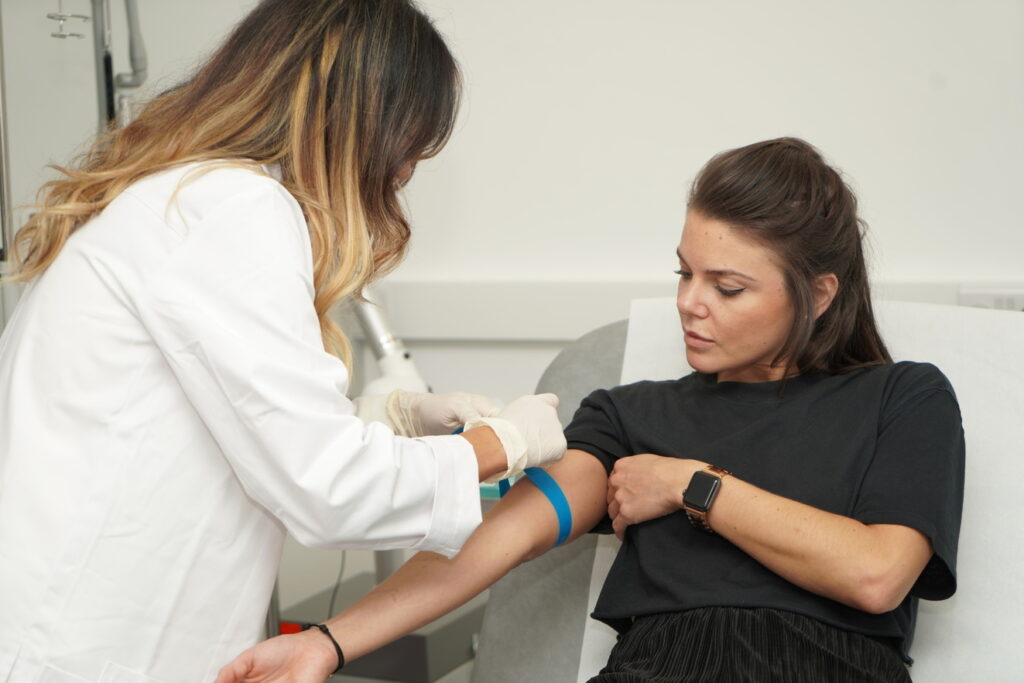
- Sample Collection: A blood sample is collected from the individual.
- Glycan Analysis: The sample is sent to a specialised laboratory where the glycans are extracted and analysed using advanced techniques.
- Calculation of Biological Age: The glycan patterns are compared to a database of thousands of samples. Based on this comparison, a biological age is calculated, reflecting the state of an individual’s immune system and overall health.
What Does the
GlycanAge Test Show?
At our offices in Cheshire & Manchester GlycanAge provides a detailed insight into your biological age, which is an indicator of your body’s functional state and overall health. This biological age can be younger or older than your chronological age (the number of years since your birth). Key aspects that the test reveals include:
- Immune System Health: Glycans are involved in the regulation of the immune system. Changes in glycan patterns can indicate how well your immune system is functioning.
- Inflammation Levels: Chronic inflammation is a significant factor in ageing and many diseases. The test can reveal the level of inflammation in your body.
- Overall Health Status: By providing a more precise measure of your biological age, the test gives a clearer picture of your general health and ageing process.
How Accurate
is the
GlycanAge Test?
The accuracy of the GlycanAge test is supported by robust scientific research and validation studies. According to the developers, the test has a high degree of reliability, with numerous studies published in peer-reviewed journals supporting its accuracy. Research has shown that glycan patterns correlate strongly with biological age and can predict various health outcomes.
However, it is essential to understand that, like all diagnostic tools, the GlycanAge test is not infallible. It should be used in conjunction with other medical evaluations and lifestyle assessments to get a comprehensive understanding of an individual’s health.
Improving Your
Biological Age
With GlycanAge Manchester & Cheshire patients understanding their biological age is just the first step. The next crucial step is to take actions that can help you improve your biological age. Here are some strategies:
1. Healthy Diet
- Balanced Nutrition: Consuming a diet rich in fruits, vegetables, whole grains, lean proteins, and healthy fats can significantly impact your biological age.
- Antioxidants: Foods high in antioxidants, such as berries, nuts, and green leafy vegetables, can help reduce oxidative stress and inflammation.
2. Regular Exercise
- Cardiovascular Activities: Activities like walking, running, and cycling improve heart health and reduce biological age.
- Strength Training: Building muscle mass through resistance exercises can also positively impact your biological age.
3. Stress Management
- Mindfulness and Meditation: Practices such as mindfulness meditation can reduce stress levels, which in turn can lower inflammation and improve immune function.
- Adequate Sleep: Ensuring you get enough quality sleep is crucial for maintaining a healthy biological age.
4. Avoiding Harmful Habits
- No Smoking: Smoking accelerates biological ageing by causing damage to your cells and promoting inflammation.
- Moderate Alcohol Consumption: Excessive alcohol intake can also negatively impact your biologic
5. Regular Medical Check-ups
- Health Screenings: Regular health screenings can help detect any issues early and allow for timely intervention.
- Personalised Medical Advice: Consulting with healthcare providers can help tailor lifestyle changes specific to your needs based on your GlycanAge results.
6. Biohacking
- Hyperbaric Oxygen: A groundbreaking study reported that HBOT can significantly increase telomere length in humans. Lengthened telomeres are associated with improved cellular health and longevity, suggesting that HBOT can have a direct impact on biological aging at the cellular level.
- Ozone Therapy: Research has shown that ozone therapy could significantly reduce oxidative stress markers in patients, suggesting its potential to combat cellular aging.
Biological Age vs. Chronological Age
To fully understand the significance of GlycanAge Manchester & Cheshire patients should be able to differentiate between biological age and chronological age.
Chronological Age
Chronological age is the actual number of years a person has lived. It is a fixed measure that increases with time and is used as a general indicator of ageing. However, it does not account for the individual differences in the ageing process.
Biological Age
Biological age, on the other hand, is a measure of how well or poorly your body is functioning relative to your chronological age. It is influenced by various factors, including genetics, lifestyle, and environmental exposures. A younger biological age compared to your chronological age typically indicates better overall health and a lower risk of age-related diseases.
Why Biological Age Matters
Conclusion
GlycanAge is a revolutionary tool that offers valuable insights into your biological age, providing a more accurate picture of your health than your chronological age. By analysing the glycans in your blood, the test can reveal crucial information about your immune system health, inflammation levels, and overall ageing process. While the test is highly accurate, it should be used as part of a comprehensive approach to health management.
Improving your biological age involves adopting a healthy lifestyle, including a balanced diet, regular exercise, stress management, avoiding harmful habits, and seeking regular medical advice. By taking these steps, you can positively influence your biological age, enhance your overall health, and potentially extend your lifespan. Our team at CLNQ are leaders in wellbeing and we offer a wide range of biohacking treatments that can help improve your biological age.
Understanding the difference between biological and chronological age is vital in the journey towards optimal health. The GlycanAge test provides a powerful tool for this understanding, allowing you to make informed decisions and take proactive steps towards a healthier, more vibrant life. Book your wellbeing consultation with us today and find out more about how to improve your biological age.
GlycanAge testing at CLNQ Manchester and Cheshire
GlycanAge is available through CLNQ Life at our Manchester clinic at Deansgate Square and our Cheshire clinic on King Street in Knutsford. The sample itself is a finger-prick taken in clinic and sent to the laboratory; results come back in a few weeks.
The part that actually matters is what happens after the result. A biological age number on its own is a talking point, not a plan. At CLNQ your result is reviewed with a clinician alongside your history and, where useful, standard blood tests and a health check — because if your glycan age comes back higher than your birth age, the useful question is which modifiable thing is driving it: visceral fat, alcohol, smoking, poor sleep, untreated hypertension, sedentary work, or in women a change in oestrogen around menopause.
It is also a test that rewards retesting. A single measurement tells you where you are; a repeat six to twelve months after changing something tells you whether the change worked. That is the reason to do it.
Patients travel to us from across Greater Manchester, Cheshire and the wider North West — Altrincham, Wilmslow, Alderley Edge, Sale, Stockport, Bolton and Warrington are all within roughly half an hour of one of the two clinics. Deansgate Square is a short walk from the Deansgate–Castlefield tram stop, and the Knutsford clinic sits on King Street with parking nearby.
CLNQ Manchester · 11 Owen Street, Deansgate Square, Manchester M15 4YB
CLNQ Cheshire · 49–51 King Street, Knutsford WA16 6DX
Call 0800 0584558 or book a consultation. A third CLNQ clinic opens at Battersea Reach in London in the first quarter of 2027.
What GlycanAge measures, and what it does not
GlycanAge measures the pattern of sugar molecules (glycans) attached to IgG antibodies in your blood. That pattern shifts in a predictable direction with age and with chronic low-grade inflammation, which is why it is used as a marker of biological rather than chronological ageing.
- What it reflects — chronic inflammatory status, which is influenced by body composition, metabolic health, activity, smoking, alcohol, sleep and sex hormones. It responds to lifestyle change over months, which makes it useful for tracking.
- What it is not — a diagnostic test. It does not screen for cancer, detect heart disease, or replace blood pressure, cholesterol, HbA1c or any part of a standard health check. A normal GlycanAge does not mean nothing is wrong, and a high one does not mean something is.
- How it compares to other biological age tests — epigenetic clocks measure DNA methylation and answer a different question. Neither is a regulated diagnostic, and results from different tests will not agree with each other. Pick one and track it rather than collecting several.
- Best used with — blood testing, a health check, and a clinician who will interpret the result in the context of the rest of you. Related services include NAD+ therapy, medical weight loss and hormone replacement.
Pricing is on our price list.
GlycanAge: common questions
What is GlycanAge and how does it work?
It is a blood test that measures the glycans — sugar structures — attached to IgG antibodies. That profile changes with age and with chronic low-grade inflammation, so it is used to estimate biological age: how your body appears to be ageing, rather than how many birthdays you have had. It is taken as a finger-prick sample in clinic and analysed in a laboratory.
How accurate is it?
It is a well-characterised research marker with a substantial body of published work behind it, and it responds reliably to real changes in inflammatory status. It is not a regulated diagnostic test, and it should not be read as a precise prediction of lifespan. Treat the number as a trend to track rather than a verdict.
How long do results take?
The sample is sent to the laboratory and results typically come back in a few weeks. We will book a review to go through them with you rather than emailing you a number without explanation.
What if my biological age is higher than my real age?
It is not a diagnosis and it is not permanent. A higher result usually points to chronic inflammation, and the things that drive it are largely modifiable: visceral fat, alcohol, smoking, poor sleep, inactivity, untreated blood pressure or blood sugar, and in women falling oestrogen around menopause. The value of the test is that it gives you something concrete to change and then re-measure.
Can I lower my glycan age?
Many people do. Because the marker tracks inflammatory status rather than something fixed, it responds to changes in weight, activity, alcohol, sleep and, where appropriate, hormone therapy. It moves over months, not weeks, so a retest is normally worth doing six to twelve months after making changes.
How often should I retest?
Once a year for most people, or six to twelve months after a deliberate change if you want to see whether it worked. Testing more often than that measures noise rather than progress.
Is it the same as an epigenetic or DNA age test?
No. Epigenetic clocks measure DNA methylation patterns; GlycanAge measures immune-system glycosylation. They are answering related questions by different routes and their numbers will not match. Neither is a diagnostic test. Choosing one and tracking it consistently is more informative than running several once.
Where can I have GlycanAge testing near me?
CLNQ offers GlycanAge at Deansgate Square in Manchester and on King Street in Knutsford, Cheshire, with a third clinic opening at Battersea Reach in London in the first quarter of 2027. Book online or call 0800 0584558.
Confident. Beautiful. Empowered.
The Leading Aesthetic and Longevity Clinic in Manchester and Cheshire
We are dedicated to helping you achieve your health and wellness goals through our comprehensive range of personalized treatments and luxury approach. Whether you’re seeking to address specific concerns, enhance your appearance, or simply optimize your well-being, we have the solution. Our team of experts is passionate about creating a welcoming and supportive environment where you can feel comfortable and confident in your journey to a more radiant you. Don’t wait any longer to start your journey to optimal health and beauty.